
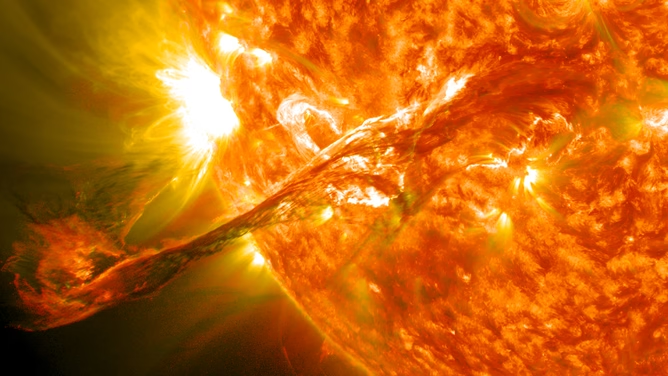
The Sun is the most important source of energy in our solar system. Every ray of sunlight that reaches Earth fuels life, drives weather patterns, and even lights up the Moon. Understanding how the Sun produces heat and light helps us appreciate the powerful forces that make our world habitable.
The sun is the life of our solar system and our planet’s rhythm. Life on Earth depends so much on this star that even the hours we use are measured with it. Scientists have argued that this giant ball of fire may someday cease to exist. Is it possible that the sun may run out of oxygen, and what will happen to our world?
According to a popular question-and-answer website by Arizona State University, the sun will eventually run out of fuel. This will be just like a cooking gas tank that goes empty or when the combustible in an automobile runs out. And yes, the sun will surely die.
However, the website explains that although our star will take about 2-3 billion years to die, it will last another 5 billion years. Long enough to see your grandchildren get married. This may explain why no one is creating projects to save the Sun.
How Long Has the Sun Been Around
The Sun, our closest star, has been shining for about 4.6 billion years and is currently in a stable phase called the main sequence. During this time, it fuses hydrogen into helium in its core, generating the energy that sustains life on Earth. Scientists estimate that the Sun will continue this process for approximately another 5 billion years before exhausting its hydrogen fuel.
After this period, it will enter a red giant phase, expanding and changing dramatically over the course of several billion years before finally shedding its outer layers and settling into a white dwarf state. This lengthy timeline means that, while the Sun’s eventual demise is certain, it will persist far longer than any human civilization or project could address, which is why there are no serious efforts to “save” the Sun.
In the meantime, humanity has plenty of time. Years enough for many generations to thrive, change, and witness events like their grandchildren’s weddings under the same glowing sky.
Nonetheless, this does answer the question about the sun’s fuel and how it produces heat and light to power our moon and world.
How Does the Sun Produce Heat and Light?
The Sun is far more than a bright object in the sky. It’s a self‑sustaining nuclear engine, a cosmic furnace that has been burning for 4.6 billion years and will continue for billions more. We depend on the Sun’s ability to generate and radiate energywarmth, weather, seasons, plant growth, ocean currents, and even the Moon’s illumination.
This article unpacks how the Sun creates heat and light, how that energy travels through space, and how it ultimately powers both our planet and our Moon.
Key Roles of the Sun
- Provides energy for life
- Drives climate and weather
- Powers photosynthesis
- Illuminates the Moon
- Influences tides through gravitational interaction
Without the Sun, neither Earth nor the Moon would function as they do today.
The sun is a ball of burning gases, and it is widely believed that fire is dependent on oxygen. Simply put, a fire needs oxygen to get started, and without it, it won’t continue to burn. However, while this is true to an extent, it is not the only gas that enables burning.
At the heart of the Sun lies its core, a region where temperatures reach about 15 million°C and pressures are unimaginably high. Under these extreme conditions, the Sun performs a process called nuclear fusion.
What is nuclear fusion?
Nuclear fusion is the process in which two light atomic nuclei combine to form a single, heavier nucleus, releasing massive amounts of energy.
- Hydrogen atoms are squeezed together so tightly that they merge into helium.
- When this happens, a small amount of mass is converted into energy.
- This energy is released as heat, light, and radiation.
As Forbes puts it, “The Sun, like the rest of the universe, is made mostly of hydrogen. There isn’t enough oxygen in the entire solar system to keep the surface of the Sun burning through chemical combustion for more than a very short time–probably hours. ”
West Texas A&M University declared in a recent research paper that the sun does not run out of oxygen for the simple fact that it does not use oxygen to burn. The burning of the Sun is not chemical combustion. It is nuclear fusion.
According to scientists at NASA, the main fuel used by the Sun is hydrogen. It produces heat and light when hydrogen atoms fuse together to form helium, emitting heat waves and energy to its surroundings.
Although this may sound like a simple process, there is an atomic process occurring inside the sun’s core. As hydrogen atoms smash into each other with exhilarating force, their protons stick together and generate heat. As expected, other nearby materials become hot and release this heat outside the core, radiating into space.
There Is No Burning in Our Star
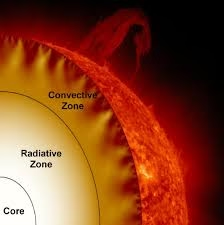
The reality does not change; hydrogen fuses and does not burn as it is believed. This means that the sun does not burn at all. According to NASA, “People, including scientists, sometimes say that the sun “burns hydrogen” to make it glow.
“But that is just a figure of speech. Hydrogen really doesn’t burn; it fuses into helium. So no oxygen is required!”
Finally, while the Sun is a huge ball of gas, there are actually no flames and no need for oxygen. After all, there is very little of this gas in the universe.
